



FASTR: The GFF Approach to Rapid-Cycle Analytics and Data Use

The GFF supports country-led efforts to improve the timely generation and use of data for decision-making, ultimately leading to stronger primary healthcare (PHC) systems and better reproductive, maternal, newborn, child, and adolescent health and nutrition (RMNCAH-N) outcomes. This set of initiatives and technical support is referred to as Frequent Assessments and System Tools for Resilience (FASTR).
Data Query
In this section, you can filter FASTR indicators by domain, round, and country to access the data most relevant to your needs. You also have the option to download the selected data for further analysis or reporting.
How to use Data Query
You can use the data query tool to apply filters by country. Further refine your results by selecting specific domains and rounds. Once you’ve made your selections, click “Apply” to update the data. To clear all filters, use the “Reset” button. After customizing your query, you can download the filtered dataset. Alternatively, you may download the complete FASTR dataset using the button below.
Note: To view subnational level indicator data, please navigate to the corresponding Country Profile, FASTR section.
Tools and Resources
Access the FASTR Resource Repository Now
The FASTR resource repository provides practical guidance for planning, adapting, implementing, and using rapid-cycle analytics to enhance data-driven decision making. Explore our curated tools, resources, data, and results specific to each FASTR technical approach by clicking the links below. For access to all resources in one place, visit the online repository.
The AI-enabled FASTR Analytics Platform allows country teams to run FASTR analyses and quickly turn the results into visualizations, dashboards, slide decks, and reports. Learn more on the platform's documentation site, or explore it firsthand in the demonstration instances in English or French.

Analysis and use of routine health management information systems data

PHC systems monitoring through longitudinal health facility phone surveys

Assessing service access, financial protection, coverage, and care experience via frequent phone surveys

Deeper understanding of key barriers, enablers, and implementation contexts to improving RMNCAH-N

What is FASTR? The GFF’s Approach to Rapid-Cycle Analytics for Data Use
Why rapid-cycle analytics?
Existing health systems data sources are critical but can sometimes come with challenges that limit their utility for country decision-makers. Health management information system data are often perceived as too low-quality to use for decision making. Traditional in-person household and facility-based surveys demand extensive resources and time to use for routine monitoring, with long lags between survey design, the collection of data, and the availability of findings for use. This prevents decision-makers from using data in a timely manner to drive meaningful improvements in health outcomes.
To fill this important gap, the GFF supports countries to develop and use rapid-cycle analytics approaches.
How does rapid-cycle analytics work?
Rapid-cycle analytics approaches provide timely, rigorous, and high-priority data that responds to each country's specific interests and data use needs. Employing a collaborative and country-led approach, these analyses are further reinforced by learning and capacity enhancing activities to use the data for practical purposes. All approaches are customized to the specific country context and aim to support country initiatives.
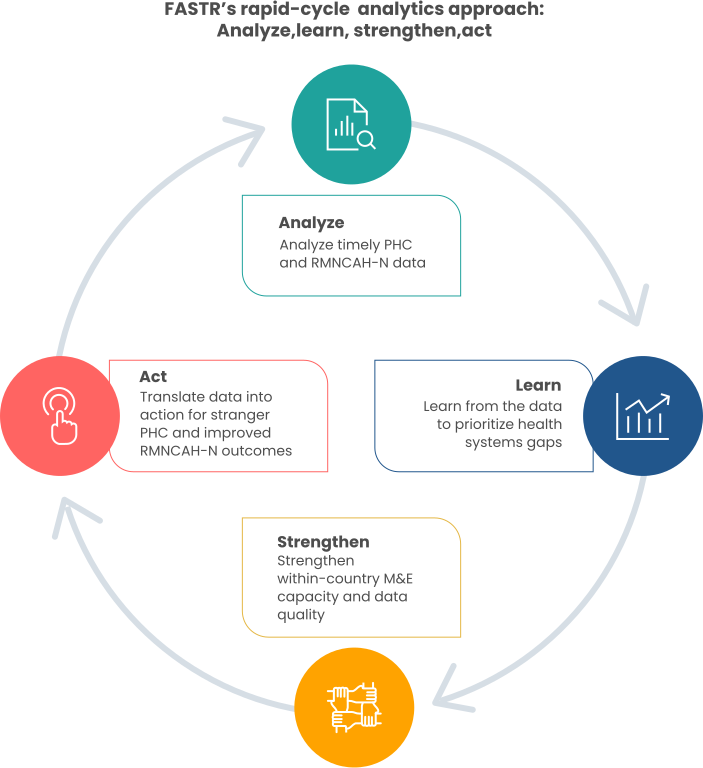
This continuous cycle of analyze-learn-strengthen-act seeks to improve the systematic use of actionable data for decision-making towards improved RMNCAH-N outcomes (Figure 1).
Figure 1. FASTR’s rapid-cycle analytics approach: Analyze, learn, strengthen, act
Technical Approaches
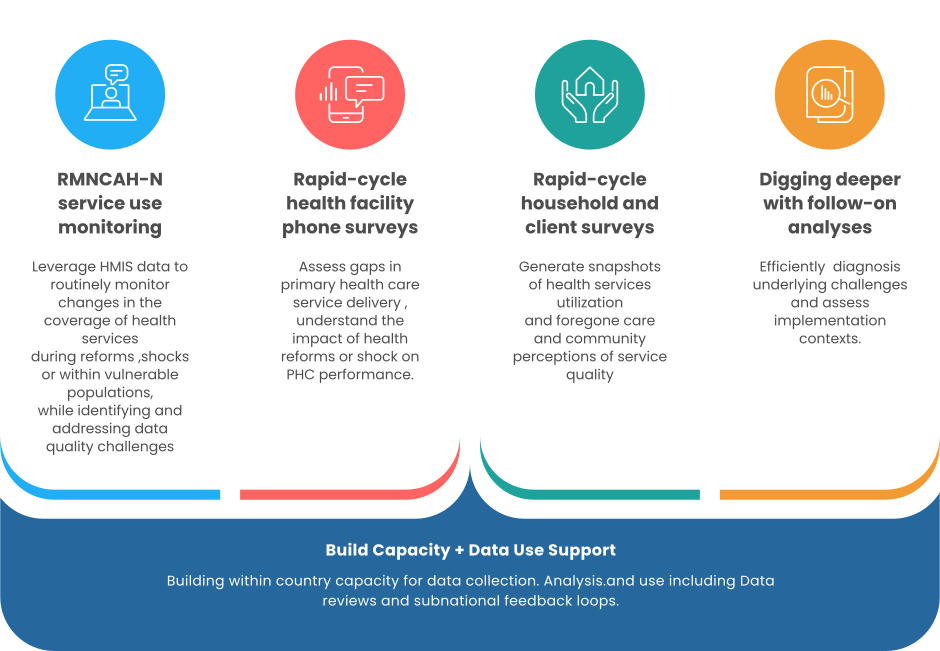
FASTR’s four technical approaches, underpinned by capacity strengthening and data use support, enable countries to use rapid-cycle analytics for strengthening PHC systems and improving RMNCAH-N outcomes through the timely and high-frequency analysis and use of data (Figure 2).
Figure 2. Rapid-cycle analytics under the Frequent Assessments and Systems Tools for Resilience (FASTR) initiative
These approaches are highly adaptable to each country's specific priorities and data use needs and are designed to be triangulated with other data sources, such as in-person household and health facility surveys.
How can Rapid Cycle analytics Support the use of Data for Decision Making?
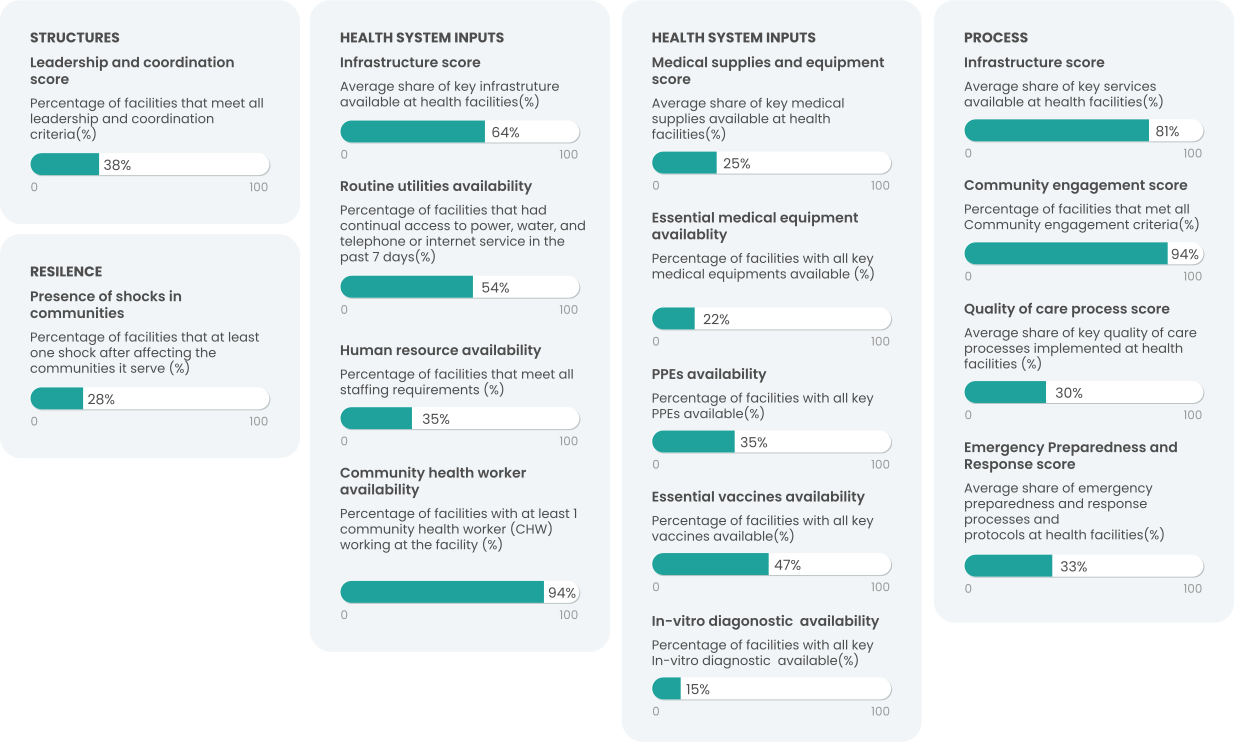
Providing an Up-to-date Snapshot of PHC Performance
Monitoring PHC health facility performance can help decision-makers identify where to direct limited resources to have the most impact.
Figure 3. Illustrative example of rapid-cycle health facility phone survey components
Monitoring Shocks Facing Health Facilities to Track their Resilience Over Time
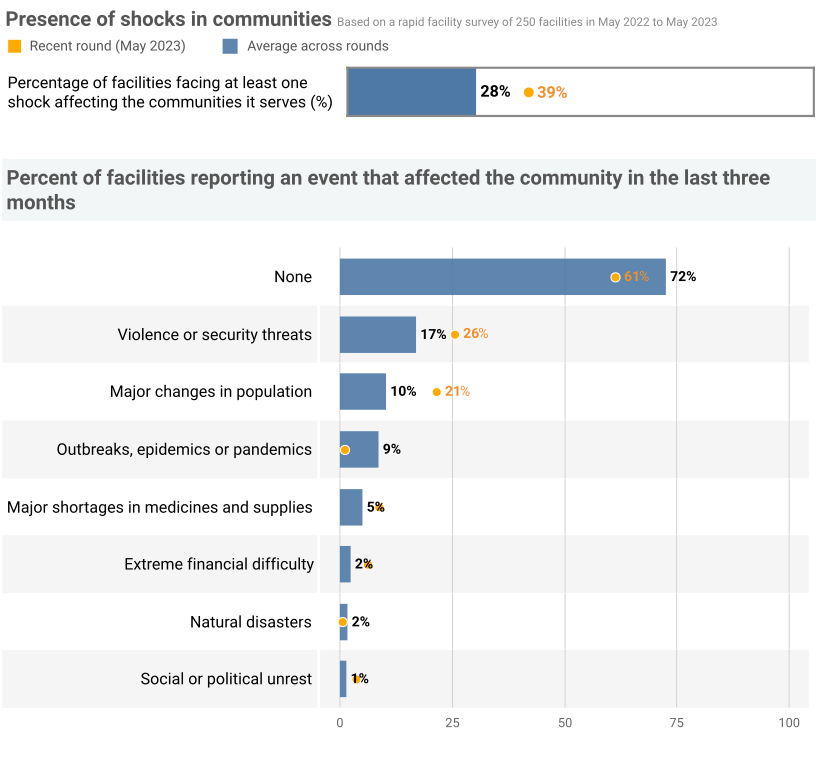
Rapid-cycle surveys capture change in the health system and the country context over time. This allows countries to track health systems resilience – how the health system absorbs, responds to, and transforms after a shock – to support preparedness, response, and recovery efforts. This illustrative graph quantifies the presence of shocks in communities over time.
Figure 4. Illustrative example of tracking shocks in communities over time
Keeping an Eye on Disruptions in Health Services
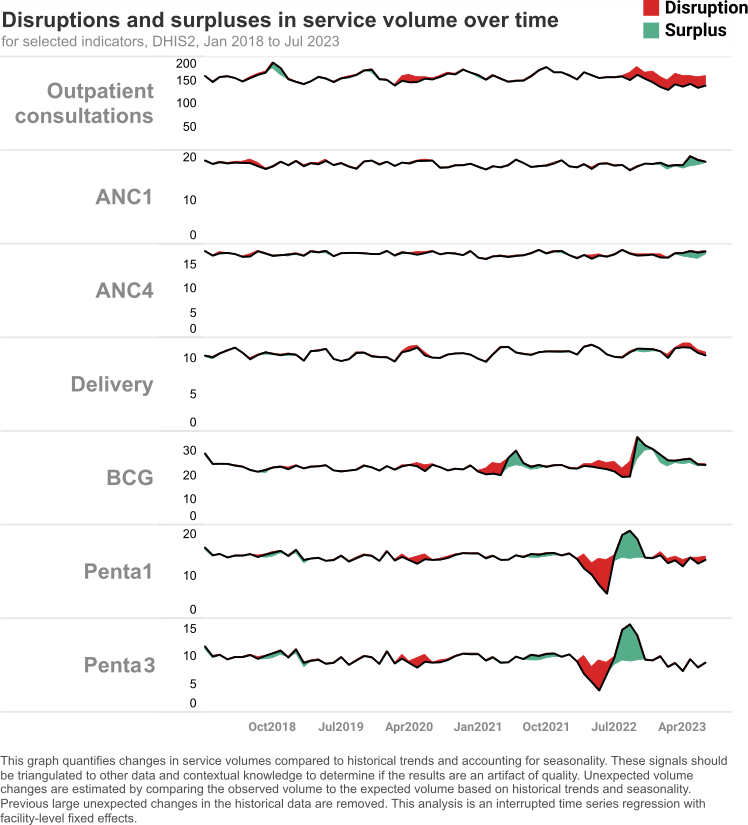
Regularly checking service volumes can spot problems quickly and help countries make decisions faster – for example, quickly identifying a decline in recorded immunizations could prompt decision makers to check for possible supply chain bottlenecks and plan catch-up campaigns.
Figure 5. Illustrative example of service disruptions
Tracking Changes in Data Quality
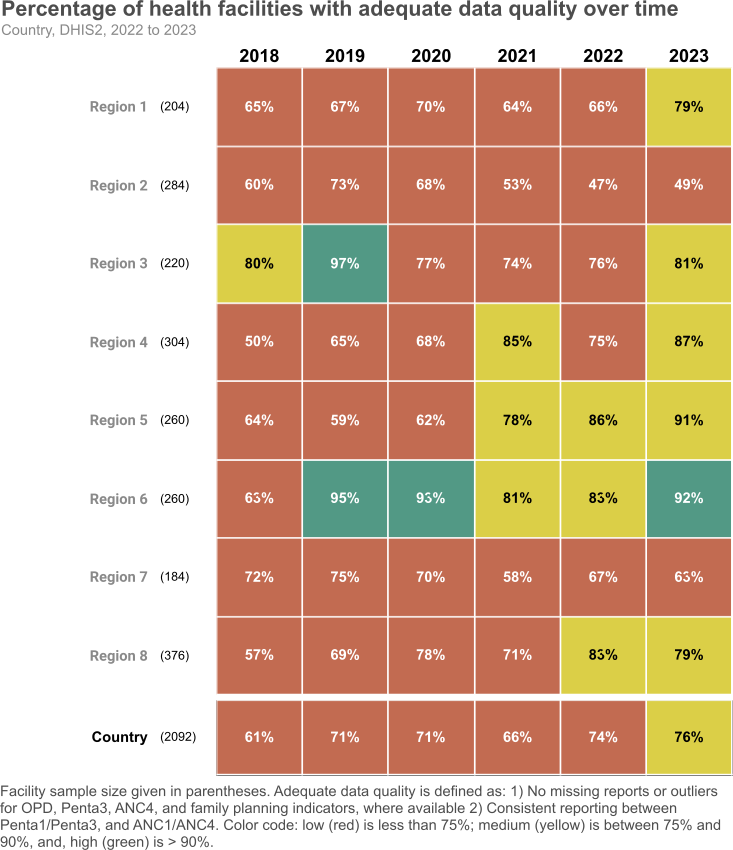
Regular evaluations of how accurate data are within the HMIS supports data quality improvements and informs which analyses are possible and how to interpret them. Analysis of facility-level data quality suggests improvements in many HMIS systems.
Figure 6. Illustrative example of tracking HMIS data quality over time and by region
Understanding the Impact of COVID-19 on RMNCAH-N Services
During the COVID-19 pandemic, the GFF supported Ministries of Health in 22 countries to track the pandemic’s impact on essential RMNCAH-N service use. These analyses showed that the COVID-19 pandemic reduced the use of childhood vaccination, outpatient consultations, maternal care, and other essential services in many GFF partner countries. Surveys of primary healthcare facilities identified challenges facing frontline health workers, including limited financing, human resources, and personal protective equipment. These findings helped to raise awareness of the impact of the pandemic on essential RMNCAH-N services and led to essential health services grants in several GFF partner countries.