



What is MAGE?

A Global Financing Facility and Johns Hopkins University partnership to advance gender results in strengthening health systems and improving RMNCAH-N outcomes for women, children, and adolescents.
Learn more about MAGE’s role at GFF
Explore Gender and RMNCAH-N Indicators
The Monitoring and Action for Gender and Equity (MAGE) initiative is a partnership between the GFF and Johns Hopkins University that supports the integration of gender and equity in GFF partner country health system reforms through evidence generation, translation, and uptake.
In alignment with the GFF Strategy 2026-2030 (Transform 2030) and its commitment to integrating gender and equity across the GFF portfolio, MAGE supports GFF and its partner countries to more effectively address gender inequality in reforming health financing, quality of care, the health workforce, and health data systems for better, more sustainable and equitable health outcomes for women, children, and adolescents.
MAGE’s Approach to Advancing Gender Equality and RMNCAH-N Outcomes
MAGE supports gender integration across GFF strategies, results-based investments, and analytical frameworks by working with governments and key stakeholders. This includes embedding gender indicators in routine and emerging data systems, and using them in analyses and dashboards to track priorities such as respectful maternal care, access to health insurance, and women’s roles in the health workforce.
MAGE also provides technical assistance, diagnostics, and targeted analytics to inform country program design, including gender indicators and DLIs. It partners with country experts and World Bank teams to advance implementation research and evidence on gender, adolescent health, and health systems reforms.
Four-Pillar Framework for Gender Integration in GFF Health Systems
MAGE developed a four-pillar framework to guide the GFF in prioritizing and measuring gender integration across supported countries.
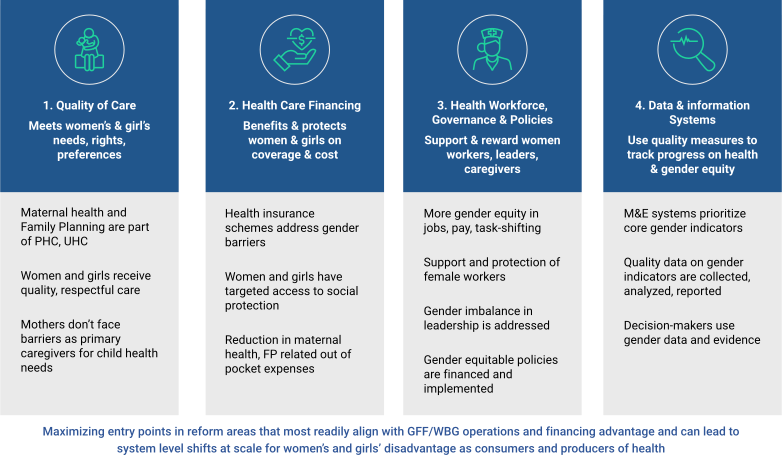
The framework embeds gender equity at the core of health systems reform—moving beyond add-on approaches to address structural disadvantages faced by women and girls as both users and providers of care.
Key areas of reform include:
- Strengthening respectful maternal and SRH care
- Expanding women’s access to health insurance and social protection
- Improving pay, conditions, and career pathways for women in the health workforce
- Integrating gender indicators into routine data collection, analysis, and use
Gender-Responsive M&E: MAGE’s Gender Data Framework
MAGE promotes gender-responsive M&E by integrating gendered needs, rights, preferences, and power relations into health system measurement.
This goes beyond sex-disaggregated indicators to include how gender norms, roles, access to resources, and decision-making power shape health outcomes and system performance.
| Gender Dimension | Description |
|---|---|
| Needs | Considers what women and girls, and men and boys need in terms of health services, programs, and care. These include vital and essential services, such as maternal health care for women and girls. |
| Rights | Considers what women and girls, and men and boys have a right to in terms of health services, programs, and care. |
| Preferences | Considers what women and girls, and men and boys want in terms of health services, programs, and care. These are often influenced by gender power relations, including access to resources, roles and practices, norms, values, and beliefs, and/or decision-making power and autonomy. |
| Power relations and systems | Considers the ways in which gender power relations and systems manifest as inequities to affect differences in health and health system outcomes and experiences at all levels, such as through inequitable: access to resources; roles and practices; norms, values and beliefs; and decision-making power and autonomy (both formal and informal). |
Types of MAGE Support to GFF Countries
MAGE works directly with GFF-supported countries to deliver:
- Diagnostics and targeted gender analyses
- Technical assistance for project design and implementation
- Integration of gender indicators and DLIs in results frameworks
- Evidence generation and implementation research on gender and adolescent health
MAGE Resources
MAGE has produced a range of resources and knowledge products to inform country, regional, and global investments, policies, programs, and measurement efforts. These include gender analytics on different topics, through technical and policy briefs, presentations, webinars, and publications. It also includes gender indicators and measurement resources, tools and frameworks, and learning materials. Explore the resources below.
Gender Tools Library
Here you will find tools to help you integrate gender into monitoring and evaluation. Included are tools focusing on gender mainstreaming, gender integration, gender analysis, and gender assessment across different health topics. There are tools across the whole project cycle from problem identification to planning, implementation, analysis, reporting, and the dissemination of results. Many of the tools have additional resources such as checklists, frameworks, and guidelines.
Gender Data Portals Library
Here you will find gender data portals which can be used to explore and analyze global, regional, and county level gender and health data. The data from these sources can be used for understanding gender inequality in national and sub-national contexts undertaking analyses to inform policy choices, assessing country progress in improving RMNCAH-N outcomes, and making informed programmatic decisions. You can search for relevant data and export and download it in most cases. Many of the data portals also have additional resources, including reports, tools, and ready to use statistics on gender, RMNCAH-N, and other health topics.