



Overview

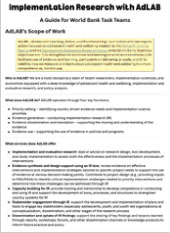
AdLAB – Adolescent Learning, Action, and Benchmarking – is an initiative for learning and action focused on adolescent health and wellbeing. Created by the Global Financing Facility and the Development Economics Research Group at the World Bank, AdLAB is a learning and implementation research platform designed to strengthen how adolescent health priorities are integrated, financed, and delivered within country systems. AdLAB supports countries to move from policy commitment to effective, measurable implementation. AdLAB brings together implementation research, measurement, and cross-country learning to generate practical evidence on what works, how it works, and under what conditions to improve adolescent health outcomes.
AdLAB directly supports the GFF’s mission to accelerate progress toward RMNCAH-N outcomes by working to close persistent implementation gaps in adolescent health. While adolescent priorities are increasingly reflected in national plans and investment cases, countries continue to face challenges translating these commitments into high-quality, adolescent-responsive services at scale. By embedding learning and accountability into implementation, AdlAB enables the GFF to invest not only in what to fund for adolescents, but how to deliver results that last.
AdLAB is supported by a multidisciplinary team of health researchers, implementation scientists, economists, and youth advocates. Our team brings a wealth of expertise in adolescent health, implementation and evaluative research, and policy analysis. AdLAB operates through four key functions:
Priority Setting: Identifying country driven evidence needs and Implementation science priorities
Evidence Generation: Conducting implementation research
Evidence Dissemination and Translation: Supporting the sharing and understanding of the evidence
Evidence Use: Supporting the use of evidence in policies and programs
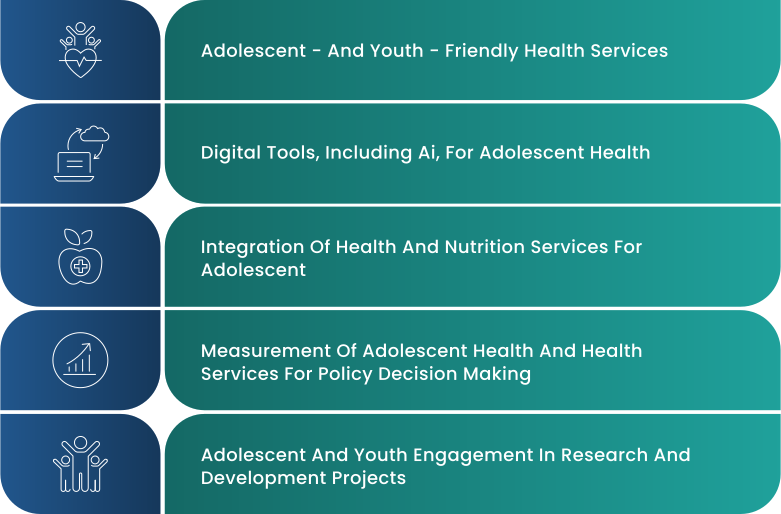
AdLAB’s Priority Thematic Areas:
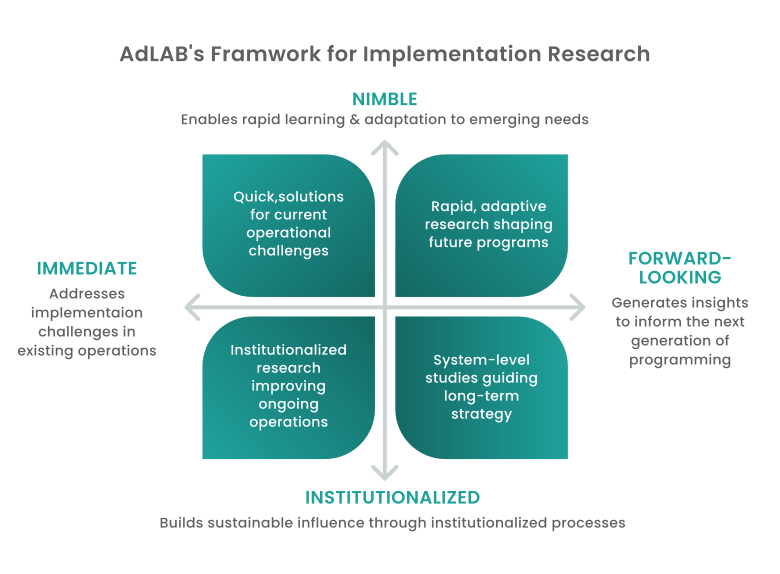
AdLAB conducts implementation research through two distinct yet complementary tracks:
- Nimble IR Track – Focused on rapid, adaptive studies that respond to emerging needs and evolving contexts.
- Institutionalized IR Track – Embedded within World Bank operations to drive long-term, system-level impact.
Both tracks can be immediate, addressing current implementation challenges, or forward-looking, generating insights to shape future programming.
Research Portfolio
Our work focuses on three core areas: strengthening adolescent integrated and essential services, building robust feedback, measurement, and accountability systems, and fostering youth engagement, leadership, and capacity building to empower young people as active agents of change.


Adolescent and Youth Health Services Policy Review
Objectives
This policy analysis assesses how adolescent- and youth-friendly health services (AYFHS) policies are defined, implemented, and monitored across 18 GFF partner countries. The analysis is presented through country-specific Policy Fact Sheets that review existing national AYFHS policies and assess their alignment with WHO quality standards, offering governments practical insights for strengthening adolescent health service policy frameworks.
Proposed Use
These policy briefs are designed to provide a concise overview of each country’s AYFHS policy alignment with global standards. Specifically, the policy fact sheets can offer government and partners clear insights to strengthen adolescent health service delivery and enable the GFF AdLAB initiative to more effectively prioritize and allocate resources for AYFHS policy implementation.
Methods
The analysis was based on a desk review of publicly available national adolescent health policies sourced from the WHO SRMNCAH National Policy Document Repository. We first identified indicators from the WHO Global Standards for Quality AYFHS, of which 278 indicators were excluded because they could not be assessed through a desk review. The remaining assessable indicators were consolidated into a final set of 52 indicators under seven quality standards:
- Adolescent Participation and Empowerment
- Inclusive, Safe, and Respectful Care
- Adolescent-Centered Service and Care Coordination
- Family and Community Engagement
- Facility Characteristics
- Providers’ Competencies, and Data and Quality Improvement
The policy fact sheets present a detailed breakdown of the 52 indicators, showing for each whether it is “fully described,” “partially described,” or “not described” in the national policy.
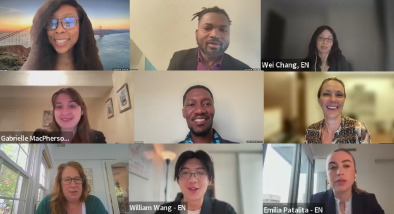
The policy review was carried out as part of a service-learning project by students from the University of Toronto: Gabrielle MacPherson, Emilia Patalita, Anna Serabian, and William Wang.

Resources and Tools
AdLAB’s Resources
AdLAB Webinars
Adolescent Health Data and Tools
This curated list brings together adolescent health and well-being indicators, key data sources, and globally recognized tools and guidance to support evidence-informed decision-making across policy, programming, and implementation. The selection emphasizes alignment with global standards, comparability across countries, and practical use for national and sub-national decision-making.
The indicators and data sources highlighted, drawing from frameworks such as GAMA and platforms like MICS, provide a harmonized foundation for monitoring outcomes and tracking progress across adolescent health domains. Complementing this, global tools and guidance help translate data into action, from national strategy and implementation (AA-HA! 2.0, Technical guidance on prioritizing adolescent health) to service quality improvement (Global Standards for Adolescent-Friendly Health Services) and scalable mental health and psychosocial interventions (HAT, EASE).
Together, these resources enable policymakers, program managers, and implementers to navigate the adolescent health landscape more coherently, strengthening planning, measurement, and accountability for adolescent-responsive systems.
ADOLESCENT HEALTH INDICATORS AND DATA SOURCES
Indicator Likely Portal/Data Source Adolescent population WHO MNCAH portal. UNICEF Adolescent Data portal Indicator Likely Portal/Data Source Substance use (alcohol use, tobacco use) UNICEF country profiles/data dashboard. WHO MNCAH portal Nutrition (thinness, obesity) UNICEF country profiles/data dashboard Physical activity UNFPA Dashboard Intimate partner violence UNICEF country profiles/data dashboard Out of school / NEET UNICEF country profiles/data dashboard. UNFPA Dashboard Child Marriage (before age 18 or 15) UNFPA Dashboard. UNICEF Adolescent Data Portal Indicator Likely Portal/Data Source Use of contraception among adolescents UNFPA Dashboard Unmet need for family planning UNFPA Dashboard Percentage of 15yr old girls received recommended dose of HPV WHO MNCAH data portal Comprehensive knowledge of HIV DHS. UNAIDS Datasheet Indicator Likely Portal/Data Source Mortality (all cause) among adolescents UNICEF country profiles/data dashboard Cause Specific Mortality (e.g. road injuries, HIV, Suicide, NCDs) UNICEF country profiles/data dashboard. WHO MNCAH portal Adolescent birth rate (15–19) / Adolescent pregnancy WHO MNCAH portal. UNFPA Dashboard. UNICEF Adolescent Data Portal Adolescents living with HIV UNAIDS data sheet New HIV infections (adolescents) UNAIDS data sheet
ADOLESCENT HEALTH GLOBAL TOOLS AND GUIDANCE
Tool / Guidance / Framework Year Domains covered Best Used for AA-HA! 2.0 (Global Accelerated Action for the Health of Adolescents) 2023 (2nd edition) Adolescent Health programming; multisectoral coordination; implementation planning; indicators. Designing and aligning adolescent health strategies and implementation plans Guidance for countries to assess adolescent health and well-being 2025 Outlines seven key domains for assessing adolescent health and wellbeing. A diagnostic and planning tool for governments to identify gaps, inform policy and financing decisions, and strengthen coordinated, evidence-based adolescent health strategies Technical guidance on prioritizing adolescent health 2017 Policy prioritization; Investment planning; country health strategy alignment. Also compliments AA-HA! National policy dialogue and investment planning Competency and outcomes framework for adolescent health and well-being 2025 Health worker competency domains for the achievement of UHC Primarily for health workforce educators to develop competency-based curricula and assessments. Plan International Adolescent Programming Toolkit (Crisis Settings) Plan International 2020 Adolescent programming in humanitarian and fragile contexts. Programming in humanitarian/emergency settings. Tool / Guidance / Framework Year Domains covered Best Used for GAMA Adolescent Health Indicators 2024 Measurement of adolescent health and wellbeing; 47 core indicators across 6 domains Selecting, harmonizing, and reporting adolescent health indicators for national monitoring Measuring Mental Health Among Adolescents and Young People at the population level (MMAPP) Brochure Indicators UNICEF / MICS 2023 Measurement of adolescent mental health at population level. standardized for cross-country comparison National surveys capturing adolescent mental health indicators Tool / Guidance / Framework Year Domains covered Best Used for Global Standards for Quality Health-Care Services for Adolescent Health 2025 Adolescent-friendly health services; quality improvement; facility-based service delivery. Includes tools, measures and indicators Assessing and improving the quality of adolescent health services Global Standards for Quality Health-care services for adolescent health 2015 Adolescent-friendly health services; quality improvement; facility-based service delivery Assessing and improving the quality of adolescent health services Implementation Guide 2015 Assessing, improving and institutionalizing adolescent responsive-health services A guide to translate the 2015 standards into practical actions for adolescent-responsive health services. Tool / Guidance / Framework Year Domains covered Best Used for International Technical Guidance on Sexuality Education (ITGSE) 2018 Comprehensive sexuality education; SRH literacy; life skills School-based adolescent SRH and life-skills programming Tool / Guidance / Framework Year Domains covered Best Used for Helping Adolescents Thrive (HAT) Toolkit 2021 Mental health promotion; prevention of mental disorders; caregiver and school interventions Mental health promotion and prevention in schools and communities Tool / Guidance / Framework Year Domains covered Best Used for EASE (Early Adolescent Skills for Emotions) 2023 Psychological interventions for early adolescents and caregivers Community-based or school-based psychosocial support Youth-Centered Digital Health Framework 2023 Digital health interventions co-designed with young people Designing digital interventions targeting adolescents